House Hacking 101: Live for Free While Building Your Real Estate Portfolio
What if your biggest monthly expense - housing - was paid entirely by someone else? That's what house hacking makes possible. It's the strategy that launches more real estate careers than any other, and it works for people with moderate income, modest savings, and zero prior investing experience.
Here's the complete beginner's guide.
What Is House Hacking?
House hacking means buying a property with multiple units, living in one of them, and renting out the others. The rental income from your tenants offsets - or ideally eliminates - your housing cost entirely.
Classic house hacking setup: buy a duplex, triplex, or fourplex. Live in one unit. Rent the rest. If the rent from the other units covers your mortgage, you live for free (or close to it) while building equity every month.
Why this is so powerful:
- You qualify for owner-occupied loan programs (lower down payment, better rates)
- You live for free or near-free, dramatically accelerating savings
- You gain hands-on landlord experience while having the property right next to you
- You build equity and create long-term rental income
The Numbers Behind House Hacking
Let's make this concrete.
Scenario: You buy a triplex for $320,000 in a mid-tier market. You put 5% down using an FHA loan ($16,000). Your PITI payment is $2,100/month.
Each of the two rental units rents for $1,100/month = $2,200/month rental income.
Your effective housing cost: $2,200 - $2,100 = $100/month profit. You're paid to live there.
After one year, you can move out, rent your unit ($1,100/month), and collect $3,300/month in gross rent against a $2,100 mortgage - generating strong cash flow on a property you bought with 5% down.
FHA Loans: The House Hacker's Best Friend
FHA loans are government-backed mortgages with lower down payment requirements. They're designed for owner-occupants - and house hackers qualify because you'll be living in the property.
FHA loan basics:
- Down payment: 3.5% with 580+ credit score; 10% with 500 - 579
- Eligible property types: 1 - 4 units (you must live in one)
- Mortgage insurance: Required (adds ~0.85% annually to your payment)
- Loan limits: Vary by county - higher in expensive areas
The FHA loan's 3.5% down payment is the key advantage. On a $300,000 triplex, that's $10,500 vs. $75,000 for a conventional 25% investment property down payment.
Important: You must move in within 60 days of closing and live in the property for at least one year. After that, you can move out and keep the FHA loan.
Conventional 5% Down for House Hacking
FHA isn't your only option. Conventional loans via Fannie Mae and Freddie Mac now allow 5% down on 2-4 unit owner-occupied properties in some programs. This avoids FHA's mortgage insurance for borrowers with 720+ credit scores.
Check with a local mortgage broker for current conventional options - the programs change.
Finding a House Hack Property
What to look for:
- 2 - 4 unit residential properties (duplexes, triplexes, fourplexes)
- In neighborhoods with strong rental demand and low vacancy
- Where gross rent from rental units approaches or exceeds your full mortgage payment
- In reasonable condition (or priced accordingly for rehab)
Where to search:
- Zillow and Redfin - filter for 2 - 4 units
- Loopnet (sometimes lists small multi-family)
- Your local MLS via a buyer's agent
- Driving neighborhoods you'd want to live in
Red flag: Many small multi-family listings are significantly underpriced because they need major work. Run a full analysis - including rehab costs - before making any offer.
Single-Family House Hacking Variations
You don't need a multi-unit building to house hack. Options include:

Basement apartment: Buy a house with a finished (or finishable) basement. Rent the basement as a separate unit. Legal requirements for a separate dwelling (egress windows, separate entrance) vary by city - research local codes.
House with ADU: Accessory Dwelling Units (backyard cottages, garage apartments) are common in many markets. Rent the ADU while you live in the main house.
Room rental: Buy a 4 - 5 bedroom home. Rent individual rooms to working professionals or students. Often generates more income than a single-unit rental - but more management headaches.
Managing Your First Tenants (Next Door)
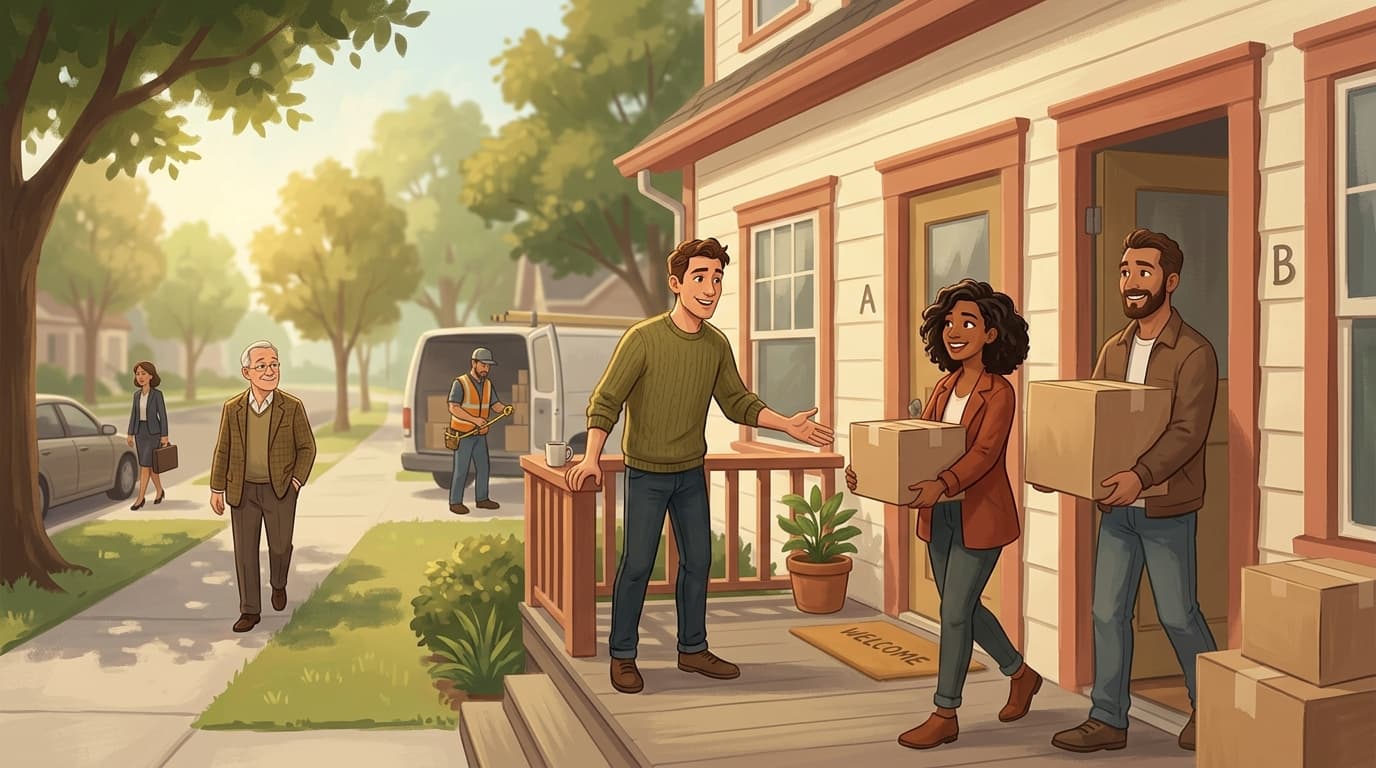
Here's the reality of house hacking that nobody talks about: your tenants are your neighbors. This can be wonderful (great tenants become friends) or nightmarish (problem tenants at 2am).
Tips for living next to your tenants:
Screen meticulously. Don't relax your screening standards because someone seems nice in person. Check credit, verify income, and call previous landlords.
Set professional boundaries from day one. You're their landlord, not their friend. Be warm and responsive, but maintain a professional relationship. Don't make verbal agreements - put everything in writing.
Use a proper lease. Get a state-specific lease form. Join your local landlord association for templates. Have a real estate attorney review it at least once.
Respond promptly to maintenance requests. Being a slow responder next door is harder to hide than when you're managing remotely. And unhappy close-proximity tenants create stress.
Have a house manual. Clear written expectations about noise, guests, parking, trash, pets, and maintenance procedures prevent most conflicts.
When to Move Out and Scale
After living in your house hack for 1 - 2 years, you have options:
-
Move out and rent your unit. Suddenly your triplex is fully rented, cash flowing strongly, and you repeat the process with a new house hack in a new property.
-
Stay and buy another. Some markets and situations make staying put financially smart while financing a second investment property conventionally.
-
Refinance. If you've renovated and forced appreciation, consider a cash-out refinance to pull equity for the next deal.
The multi-property path usually starts like this: House Hack 1 → Move Out → House Hack 2 → Move Out → 4-unit house hack 3 → etc. Within 5 - 7 years, many disciplined house hackers have 3 - 4 properties.
Is House Hacking Right for You?
House hacking works best for:
- Single people or couples without children (or with flexibility on neighbors)
- People willing to trade perfect privacy for significant financial gain
- Investors who want hands-on experience before managing properties remotely
- Those with modest savings who want a low-cost entry point
It's less ideal for:
- Families with strong space/privacy needs
- Markets where multi-family properties have very low cap rates
- People who can't tolerate occasional landlord responsibilities
Final Thoughts
House hacking is arguably the single best way to start real estate investing. The combination of low down payment financing, reduced housing costs, forced savings, and equity building is unmatched by any other beginner strategy.
The best time to house hack is before major life changes lock you into a particular lifestyle. If you're in your 20s or early 30s, single or with a flexible partner, and you want to accelerate your financial independence - start here.
Run the numbers on duplexes and triplexes in your target market today. You might be surprised how many of them nearly or fully cover your mortgage.
Frequently Asked Questions
- What is house hacking?
- House hacking means buying a property with multiple units, living in one unit yourself, and renting out the others. The rental income from your tenants offsets or eliminates your housing payment. Common house hack properties are duplexes, triplexes, and fourplexes, but single-family homes with ADUs or extra bedrooms also work.
- Can you house hack with an FHA loan?
- Yes, and this is one of the main advantages of house hacking. You can use an FHA loan with as little as 3.5% down on a property with up to 4 units, as long as you live in one of them. Conventional owner-occupied financing also works and may offer better rates for buyers with strong credit.
- How much can you save by house hacking?
- It varies significantly by market and property, but many house hackers reduce their monthly housing cost to zero or close to it. In some cases, the rental income from other units actually exceeds the total mortgage payment, meaning you're paid to live there. Even reducing a $2,000 mortgage payment to $500 out of pocket saves $18,000 per year.
- What types of properties work best for house hacking?
- Duplexes, triplexes, and fourplexes are the most common and efficient house hacking vehicles because they allow owner-occupied financing on true multi-family properties. Single-family homes with a finished basement, garage apartment, or ADU also work well. Some investors buy larger single-family homes and rent out individual rooms.
- Do you have to be a landlord to house hack?
- Yes, but on a small scale. When you house hack, you're the owner of the property and your tenants rent from you. This means handling maintenance requests, collecting rent, and managing the landlord-tenant relationship. Living on site makes this easier since you're immediately available, but it also means you're neighbors with your tenants.
Enjoyed this article?
Get our free starter kit and more guides like this.