Multi-Family vs. Single Family Real Estate: Which Should You Buy First?
One of the most common questions new real estate investors ask is which to start with - a single-family home or a small multi-family property like a duplex or triplex.
Both work. The "right" answer depends on your specific situation. But there are real differences in how these investments behave, and understanding them before you buy will save you from choosing the wrong starting point.
What We Mean by Multi-Family
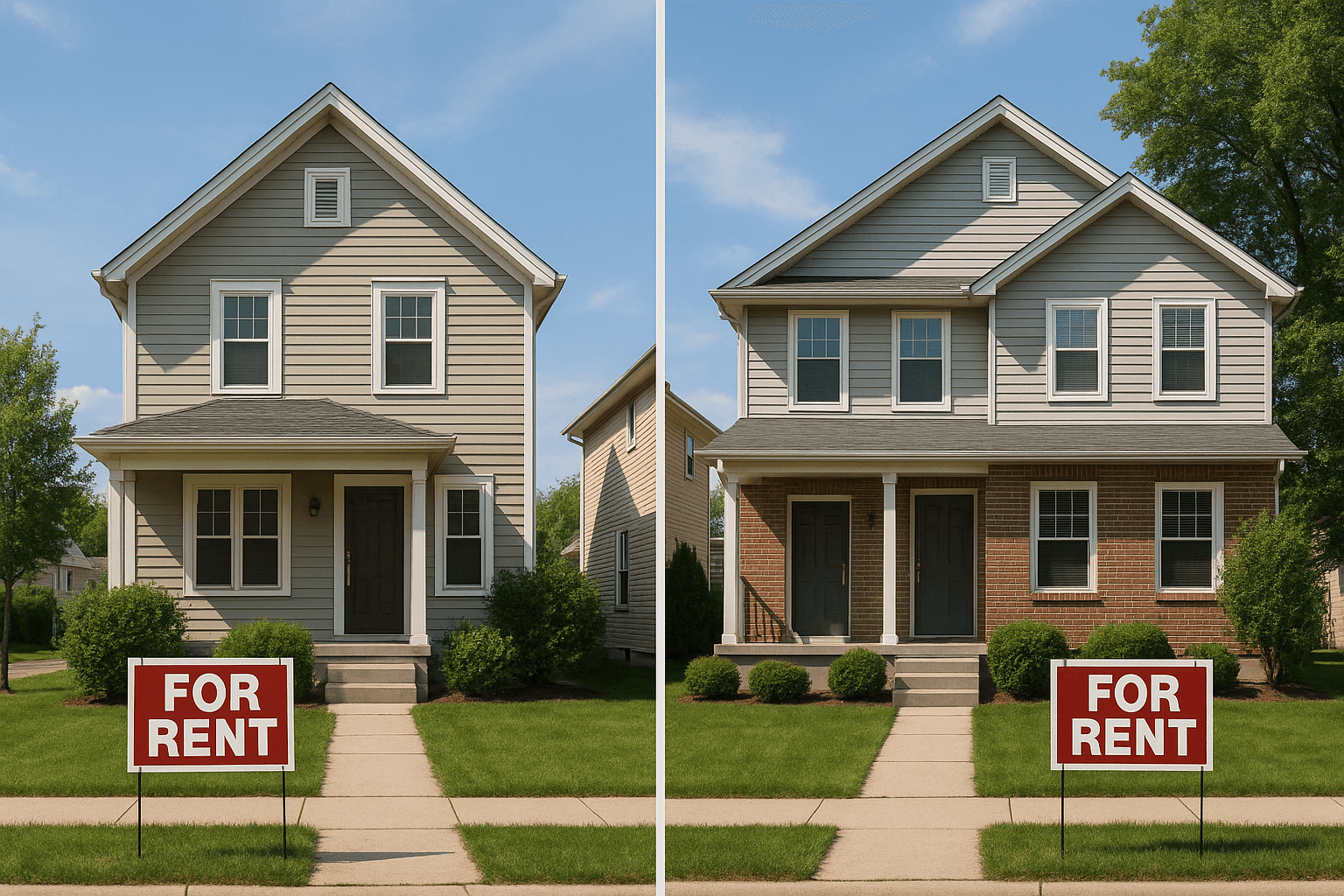
When investors say "multi-family," they usually mean small residential multi-family - properties with 2 to 4 units (duplexes, triplexes, and fourplexes). These qualify for residential financing (FHA, conventional), making them accessible to beginners.
Properties with 5+ units shift into commercial multi-family (apartment buildings), which require commercial loans, larger down payments, and more complex underwriting. That is a separate conversation.
For this article, multi-family means 2-4 units.
The Core Difference: Income Diversification
The most important difference between single-family and multi-family is what happens when a unit is vacant.
Single-family vacancy: If your tenant moves out, your income drops to zero. Your mortgage, taxes, and insurance keep coming. You absorb 100% of the cost until you re-rent.
Multi-family vacancy: If one tenant in a fourplex moves out, you lose 25% of income - but collect 75%. The property continues generating cash while you find a replacement tenant.
This income diversification is why experienced investors often prefer multi-family as a risk management tool, especially in slower rental markets where vacancies linger.
Financing: Where Single-Family Has the Edge
Single-family homes are simpler and often cheaper to finance.
Conventional loans on single-family: Widely available, competitive rates, straightforward underwriting. If you are buying as an investment (not owner-occupied), expect 20-25% down and rates typically 0.5-0.75% higher than owner-occupied.
Conventional loans on 2-4 unit (investment): Also available, but typically require 20-25% down on a 2-unit and 25% on a 3-4 unit. Rates are similar but lenders may scrutinize the investment more carefully.
FHA loans: Available for both single-family and 2-4 unit properties when you live in the property (owner-occupied). This is where multi-family gets its biggest advantage for beginners - the house hacking strategy. Buy a 2-4 unit with 3.5% down using FHA, live in one unit, rent the others. The rental income subsidizes your mortgage.
Key point: If you are buying purely as an investor (not living there), single-family and small multi-family have similar financing requirements. If you plan to house hack, multi-family opens up owner-occupant financing with dramatically lower down payments.
Cash Flow: Multi-Family Typically Wins
More units generally means more total rent, which means more cash flow potential.
Example comparison:
Single-family home, $220,000 purchase:
- Monthly rent: $1,600
- Mortgage (20% down, 7%, 30yr): $1,173
- Expenses (taxes, insurance, management, maintenance): $550
- Monthly cash flow: roughly -$123 (slightly negative)
Duplex, $310,000 purchase:
- Total rent (2 units x $1,050): $2,100
- Mortgage (20% down, 7%, 30yr): $1,651
- Expenses: $700
- Monthly cash flow: roughly -$251... wait.
The duplex has more gross income but also a bigger mortgage. What matters is the rent-to-price ratio on each unit.
Better duplex example, $260,000 purchase:
- Total rent (2 units x $975): $1,950
- Mortgage (20% down, 7%, 30yr): $1,386
- Expenses: $650
- Monthly cash flow: roughly +$86
The numbers work or do not work based on purchase price relative to rents - not property type alone. In many markets, multi-family properties trade at prices that produce better rent-to-price ratios than comparable single-family homes, which is why investors often prefer them for cash flow.

Management: Single-Family Is Simpler
Single-family homes are easier to manage.
One tenant, one lease, one set of utilities, one maintenance relationship. Tenant turnover involves one unit. Issues involve one household.
Multi-family introduces complexity:
- Multiple leases to track and renew
- Multiple tenant relationships (including neighbor conflicts between your tenants)
- Potentially shared utilities to split fairly
- More maintenance calls, more wear on shared spaces (hallways, laundry, parking)
For a first-time investor who also has a full-time job, the simplicity of a single-family home has real value. You are less likely to make management mistakes that cost you money.
That said, the operational difference between managing a duplex and managing a single-family is not dramatic - it is manageable for most people. A 4-unit is noticeably more work, but still far simpler than a 20-unit apartment building.
Appreciation: Generally Comparable
Single-family homes and small multi-family properties in the same neighborhood tend to appreciate at similar rates over time. Both are driven by local housing demand, economic conditions, and supply constraints.
One nuance: multi-family properties in many markets have seen strong appreciation driven by investor demand and housing shortages. But single-family homes in growing suburban markets have also appreciated strongly. Location matters far more than property type for appreciation.
Which Should You Buy First?
Buy single-family if:
- You want the simplest possible first deal to learn on
- You are buying in a market where single-family rent-to-price ratios are strong
- You do not plan to live in the property and house hacking is not part of your strategy
- You are risk-averse and want one simple tenant relationship
Buy multi-family (2-4 units) if:
- You want to house hack - live in one unit and dramatically reduce your down payment
- You want income diversification from day one (vacancy in one unit does not stop cash flow)
- You are comfortable managing multiple tenants
- You want to scale faster - one purchase gives you multiple rental units and multiple streams of income
The honest take: For most beginners who are willing to live in the property for 12-24 months, a duplex or triplex with FHA financing is the superior starting point. The combination of low down payment, owner-occupant rates, and immediate income diversification is hard to beat.
For investors who are not house hacking and are buying purely as a rental, both work. Run the numbers in your target market. If single-family rent-to-price ratios are stronger, buy single-family. If multi-family properties offer better income relative to price, go multi-family.
Scale Over Time
Many successful real estate investors follow a progression: start with a house-hacked duplex, move out after a year, rent all units, repeat with a new house hack. After 5-10 years, this pattern produces a portfolio of 2-4 unit properties all acquired with low down payments and owner-occupant financing.
Others prefer to build a portfolio of single-family homes in strong rental markets, leveraging the simplicity of management and the deep pool of buyers when they eventually sell.
Both paths work. The worst decision is not choosing one over the other - it is waiting too long trying to pick the perfect strategy while the right deal passes by.
Start with the approach that fits your current situation, run conservative numbers, and buy a good deal.
Frequently Asked Questions
- What is the main difference between multi-family and single-family rentals?
- A single-family rental is a standalone property rented to one household. A multi-family property (duplex, triplex, apartment building) has multiple separate units generating multiple income streams. Multi-family offers more income diversification and often stronger cash flow, while single-family is easier to finance, manage, and eventually sell.
- Which is better for beginners, single-family or multi-family?
- Most beginners do better starting with single-family or small multi-family (2 to 4 units). These properties qualify for standard residential financing, are easier to manage, attract longer-term tenants, and have larger buyer pools when you sell. Large apartment complexes require commercial financing, more management complexity, and significantly more capital.
- Do multi-family properties cash flow better than single-family?
- Often yes, because multiple rental streams give you more income per dollar of property value, and vacancy in one unit doesn't eliminate all income. However, multi-family also comes with higher management costs, more tenant turnover, and more maintenance. The cash flow advantage depends heavily on the specific property and market.
- What counts as multi-family for financing purposes?
- Properties with 2 to 4 units are classified as residential and can use conventional or FHA financing. Properties with 5 or more units are classified as commercial and require commercial loans with different underwriting standards, larger down payments (typically 25 to 30%), and terms based on the property's income rather than your personal finances.
- Can I house hack with a multi-family property?
- Yes, and this is one of the most popular house hacking strategies. Buy a duplex, triplex, or fourplex with an owner-occupied loan (FHA or conventional), live in one unit, and rent the others. The rent from your tenants partially or fully covers your mortgage. After a year, you can move out and convert the whole property to a traditional rental.
Enjoyed this article?
Get our free starter kit and more guides like this.