
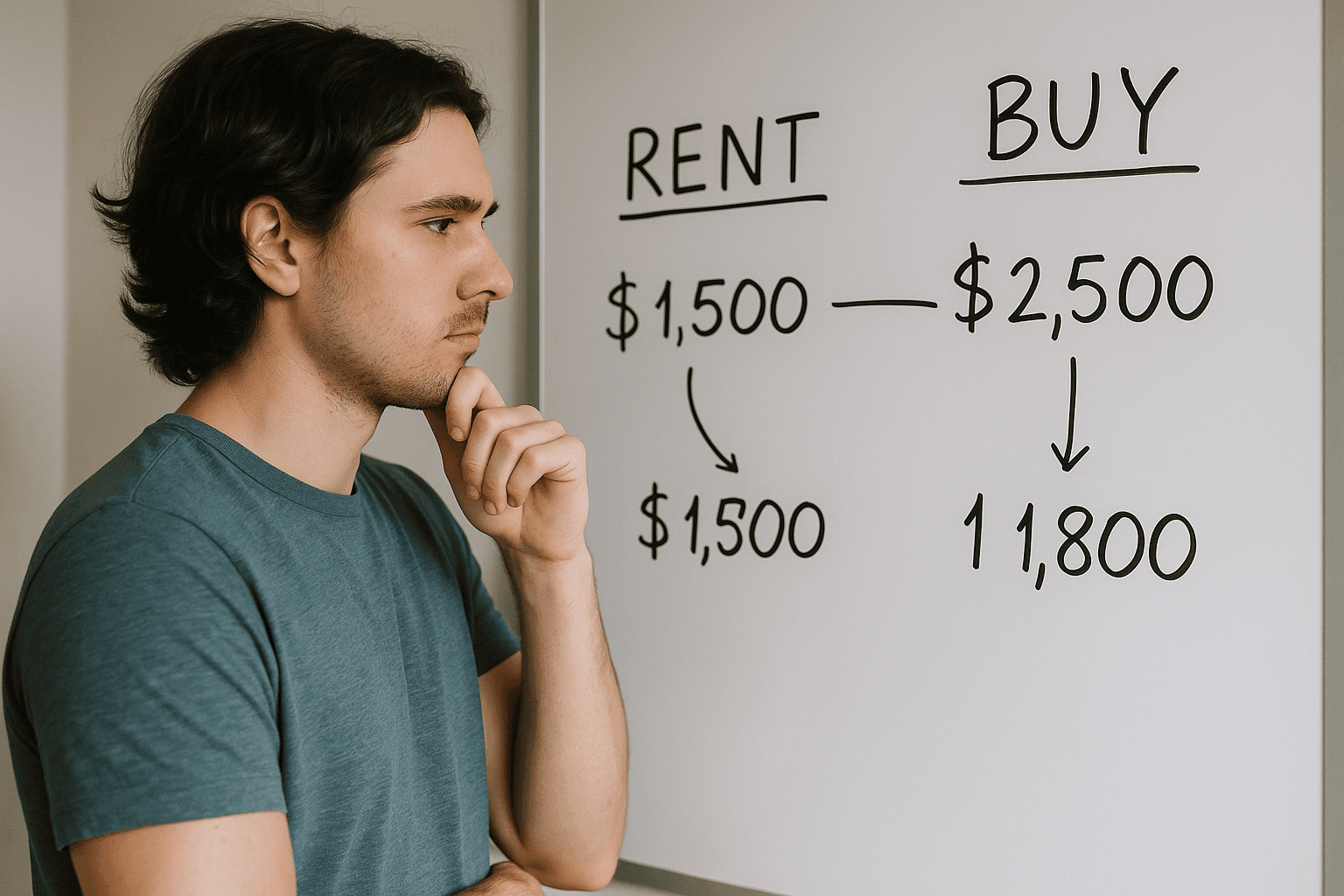
Renting vs Buying: The Honest Math
"Renting is throwing money away." You've heard this a hundred times. It's also not quite true — and believing it has led a lot of people to buy houses at the wrong time for the wrong reasons.
The real question isn't "is renting bad?" It's: given my specific situation, which option leaves me better off financially over a specific time horizon?
Let's do the math honestly.
📖 Definition
The rent vs. buy decision compares the total financial cost of renting a home against the total financial cost of buying one — including mortgage payments, taxes, insurance, maintenance, and the opportunity cost of the down payment.
What Buying Actually Costs
Most people calculate buying costs as just the mortgage payment. That's incomplete. Here's the real list:
- Mortgage principal + interest (the most obvious one)
- Property taxes (1–2% of value annually in most states)
- Homeowners insurance (~$150–$300/month for a median home)
- PMI (private mortgage insurance if you put less than 20% down — ~0.5–1% of loan value annually)
- HOA fees (varies wildly — $0 to $1,000+/month)
- Maintenance and repairs (budget 1–2% of home value annually)
- Closing costs on the purchase (2–5% of purchase price)
- Closing costs when you eventually sell (5–6% in agent commissions + fees)
On a $400,000 home, that's easily $500–$1,000/month in costs on top of the mortgage — costs many first-time buyers don't fully account for.
What Renting Actually Costs
Renting is simpler to calculate:
- Monthly rent (all-in)
- Renter's insurance (~$15–$30/month)
- That's basically it
The renter also keeps their down payment liquid. If they invest that money instead, it generates returns. This is the opportunity cost that changes the whole equation.
The Opportunity Cost Argument
Here's what gets left out of most rent vs. buy comparisons.
If a buyer puts $80,000 down on a $400,000 home, that $80,000 is now locked in the property. A renter keeps that $80,000 and can invest it.
Over 10 years at a 7% average annual return, that $80,000 grows to about $157,000. That's roughly $77,000 in investment gains the buyer forfeited by putting the money in a down payment instead of the market.
This doesn't mean renting is better — it means the comparison is more nuanced than people assume.
📝 Example
Buyer: Purchases a $400,000 home with $80,000 down at 7% interest. Total monthly cost (mortgage + taxes + insurance + maintenance) ≈ $3,200/month.
Renter: Rents a comparable home for $2,400/month and invests the $80,000 down payment + $800/month savings (the difference from not buying) at 7%.
Over 10 years: The buyer has built meaningful equity (~$90,000) and the home may have appreciated. But the renter's invested portfolio may be worth $250,000+. The "winner" depends heavily on how much the home appreciates.
Use our Rent vs Buy Calculator to model your specific numbers.
When Buying Wins
Buying tends to come out ahead when:
You stay long enough. The break-even point on buying (when it becomes cheaper than renting) is typically 5–8 years in most markets, after accounting for all costs. The longer you stay, the more buying wins.

The market appreciates. If your home gains 3–5% per year, that appreciation builds wealth that renting can't replicate.
You buy in a cash-flow-favorable market. In some markets, you can buy a home and the "total cost of ownership" is actually close to or below comparable rent. This is rare in high-cost markets but common in the Midwest and Southeast.
You want stability and control. Not financial, just lifestyle. No landlord, no lease renewals, you can paint the walls.
When Renting Wins
Renting tends to be smarter when:
You're not staying long. Buying and selling within 2–3 years almost always loses money after transaction costs. If there's any chance you'll move, renting preserves flexibility.
You're in a very expensive market. In cities like San Francisco, New York, or Seattle, price-to-rent ratios are extreme. The math heavily favors renting and investing the difference — unless you believe in strong long-term appreciation.
You'd be house-poor. If buying stretches your budget so tight that you can't save, invest, or handle emergencies, renting (even if "more expensive" on paper) is the smarter call.
The market is overheated. Buying at the peak of a market cycle with high rates and high prices stacks the odds against you.
💡 Tip
The rent vs. buy decision is personal, not universal. What's right for a 28-year-old in a stable job in Columbus, Ohio is different from what's right for a 28-year-old in a volatile tech career in San Francisco. Model your own numbers.
The Variables That Change Everything
Small changes in assumptions create big differences in outcomes:
- How long you stay: 3 years vs. 10 years changes the math dramatically
- Home appreciation rate: 2% vs. 5% annually makes a huge difference over time
- Investment return assumption: If you'd leave the down payment in savings (1%) vs. in equities (7%), the renter's opportunity cost story changes completely
- Rent growth: If your rent increases 5%/year, buying starts looking better faster
This is why we built the Rent vs Buy Calculator — to let you plug in your real numbers instead of relying on generic advice.
The Real Answer
Buying isn't always better than renting. Renting isn't throwing money away — you're paying for housing and flexibility. Buying isn't always building wealth — you're paying for ownership and stability.
The best decision is the one that fits your timeline, your market, and your financial situation.
Run the numbers. Be honest about how long you'll stay. And don't let a cultural assumption override your own math.
Next Steps
- Model your own scenario with the Rent vs Buy Calculator
- Learn How to Calculate Cash Flow if you're considering becoming a landlord instead
- Read about House Hacking — a way to buy a property and have tenants reduce your costs
Enjoyed this article?
Get our free starter kit and more guides like this.